Journal ·
AI in the garden
By MattI'm Matt. I'm building Wyrtun, which uses AI to help people understand and care for their gardens. I'm also a software developer, which means I'm watching the AI conversation happening in garden design from two angles at once - as someone building one of these tools, and as someone whose own profession has been going through this for a while.
This isn't the company line as such. It's me thinking out loud about what I've noticed and what I'm still uncertain about. I'd be grateful for your feedback.
The bit I can't smooth over
The model Wyrtun runs on was trained on material that wasn't licensed and in most cases the authors weren't even asked nicely. Some of that material was written by designers and writers I admire enormously. I've written about how I think about this on the Wyrtun ethics page and I'd rather you read that than have me repeat it here.
I don't think the issue is settled. I don't think my product is clean of it. The legal answer will come slowly, court case by court case. The ethical answer is one I'm working out as I build.
What we've seen in other professions
I'm watching this from the software side, so I'll start there but I'll try not to make a meal of it.
Junior tech hiring has collapsed. UK tech graduate roles fell 46% in 2024 (Institute of Student Employers). One senior developer with an AI assistant could build what a senior plus a couple of juniors used to ship between them, and the economics were too obvious for boards to ignore. Then the bit nobody saw coming: the senior developers leaning hardest on AI started producing subtly broken software - bugs that were hard to find, security holes, code that worked until it didn't. 95% of developers now report spending extra time fixing AI-generated code, and 65% of them do it frequently enough to call it part of the job (Fastly developer survey, July 2025, n=791). The work didn't vanish. It moved up the ladder, and it turned out the bottom of the ladder had been doing something important all along.
The closer parallel for garden design isn't software, though, it's architecture. When CAD arrived, architects were told the craft was dead. It wasn't - but the work changed. The architects who survived stopped spending evenings inking drawings and started doing more of what they were actually trained for: site judgement, client conversation, the decisions that determine whether a building belongs where it stands. The technical execution got faster. The thinking got more important. Today the same thing is happening again with AI - early-stage concept renders, energy modelling, parametric tooling - and the same pattern is emerging. The architects competing on the speed of producing drawings are in trouble. The ones whose value was always judgement and relationship are doing fine, and in many cases doing better.
The pattern across every profession AI has touched is the same. The work that gets eaten is the work that was already generic. The work that holds its value is the work where the person is the reason it was commissioned. For garden designers, that means the part of the job AI can't touch is also the part most clients are actually paying for - the walk around the site in March, the read on what the client actually wants when they don't quite know how to say it, the judgement that the existing yew is sulking rather than dead, the knowing that this particular slope will do better with Hakonechloa than the Stipa the plan said. None of that is in any model. None of it is being replaced by anything. AI is going to make the gap between competent execution and real design more visible, not less.
Why I'm hopeful anyway
What we're building still amazes me, daily. Last month I asked Wyrtun for ideas for a difficult bit of garden - the strip between the decking and a small wildlife pond that was built on a whim with about 20 minutes of discussion. It came back with this:
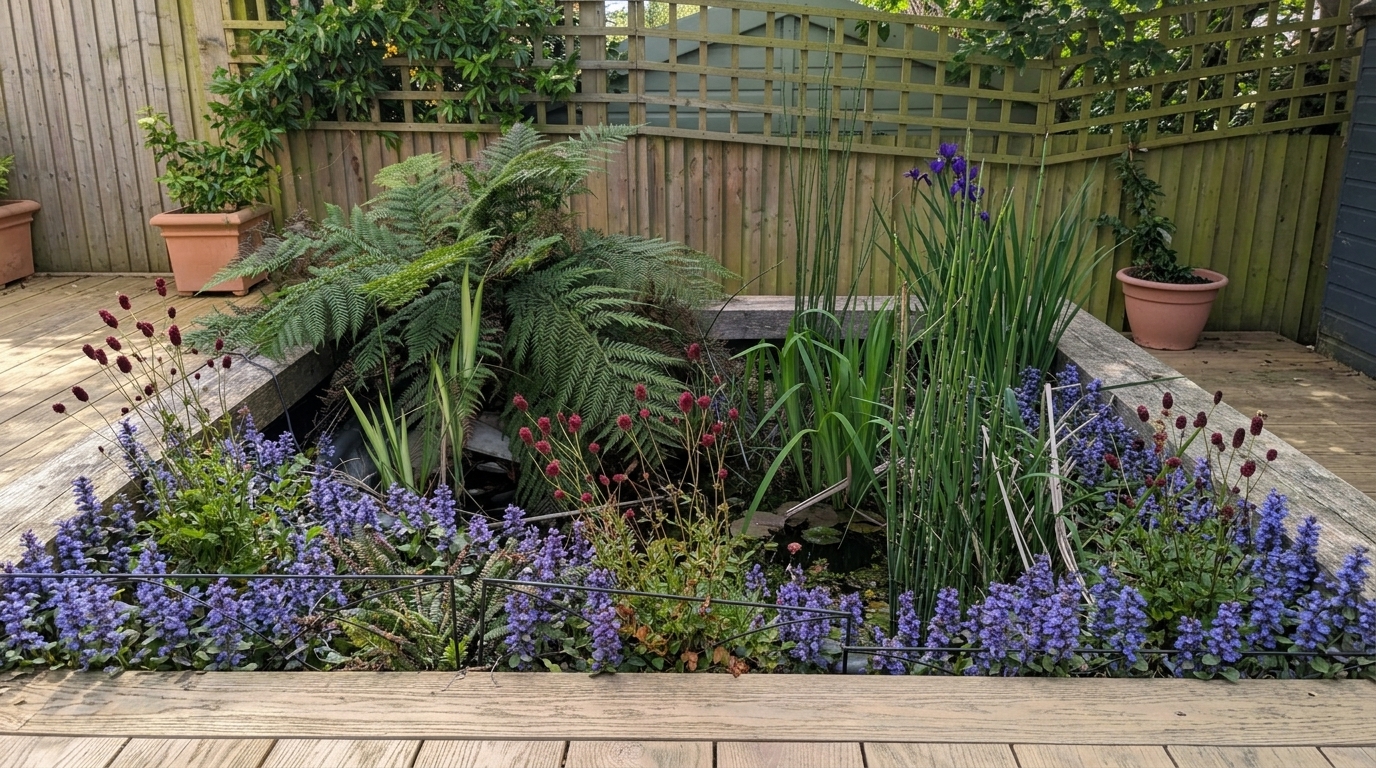
Hoverfly Shelf and Shadow Edge - Wyrtun, 19 May 2026
A creeping base of Ajuga reptans, clumps of Sanguisorba officinalis for mid-storey height, an Iris sibirica accent rising out of the water. Pitched as a self-sustaining insect corridor between decking and water, with pollinator interest from April through to September. Will it work? Probably, if I remember to keep an eye on it - "work" is doing some heavy lifting here. Can I continue to ask Wyrtun questions about the plant choices, can I learn about the ecological impact, the insects, the nature? Yes, all of these! Has it stolen work from a garden designer? Absolutely not, under no circumstances would I have been brave enough to ask a real professional for advice on this tiny strip of earth. I love my pond but I'm not sure anyone else would.
That's the bit I find hardest to write about without sounding like marketing. But it's genuinely the reason I'm building this. Not because AI is going to replace garden designers. Because there's a kind of help available now that wasn't available before, and quite a lot of it is wonderful, and I want to be honest about both the wonder and the worry.
What Wyrtun actually is, in case it matters
A patient and friendly companion, not a designer. You tell it what's in your garden - the awkward shaded bit, the wall you've been ignoring, the plant whose name you've forgotten - and it helps you make sense of what you've got and what it could become. It can produce a visualisation, suggest combinations, flag what's struggling, tell you what to do with a spare two hours on a Sunday. And like every other gardening app you've ever downloaded, of course it can take a photo of your Musa basjoo and tell you you've overwatered it.
For people who'd never hire a designer - the homeowners who currently buy on impulse at the garden centre and end up with a bed that struggles - that companion is probably the most useful thing about it. They get something better than they'd otherwise have.
For garden designers, whether AI in general is useful is a question I'm not going to answer for you. I can see places it might earn its place - the dull cross-referencing that eats an evening, early sketches and mood-setting when a client wants to see options. I can also see the case for finding the whole category irrelevant, or actively annoying. Both reactions are reasonable and I'm not in a position to tell either group they're wrong.
One thing I keep coming back to is handover. There's nothing special in the product for it - it'd just be normal use - but a designer could set up the garden in Wyrtun once their work is finished. The plants in their right places, the soil notes, the maintenance rhythm. From then on the client has something that helps them keep your work alive: the plants thrive, they know what to do in February, they don't accidentally water the plants that love dry soil because Wyrtun says they've had enough. Your work keeps doing its job in the years after you've left the site.
That's where AI can add value, making gardens work the way the designer intended.
Garden designers, if you're reading this
What would really help is honest criticism. The version of this tool that doesn't help anyone is the one I build in isolation. If you've read this far and you think I'm missing something - about the technology, the profession, the ethics, anything - I'd be grateful to hear it.
My email is matt@contact.wyrtun.com. I read everything that I am sent.
- Matt